

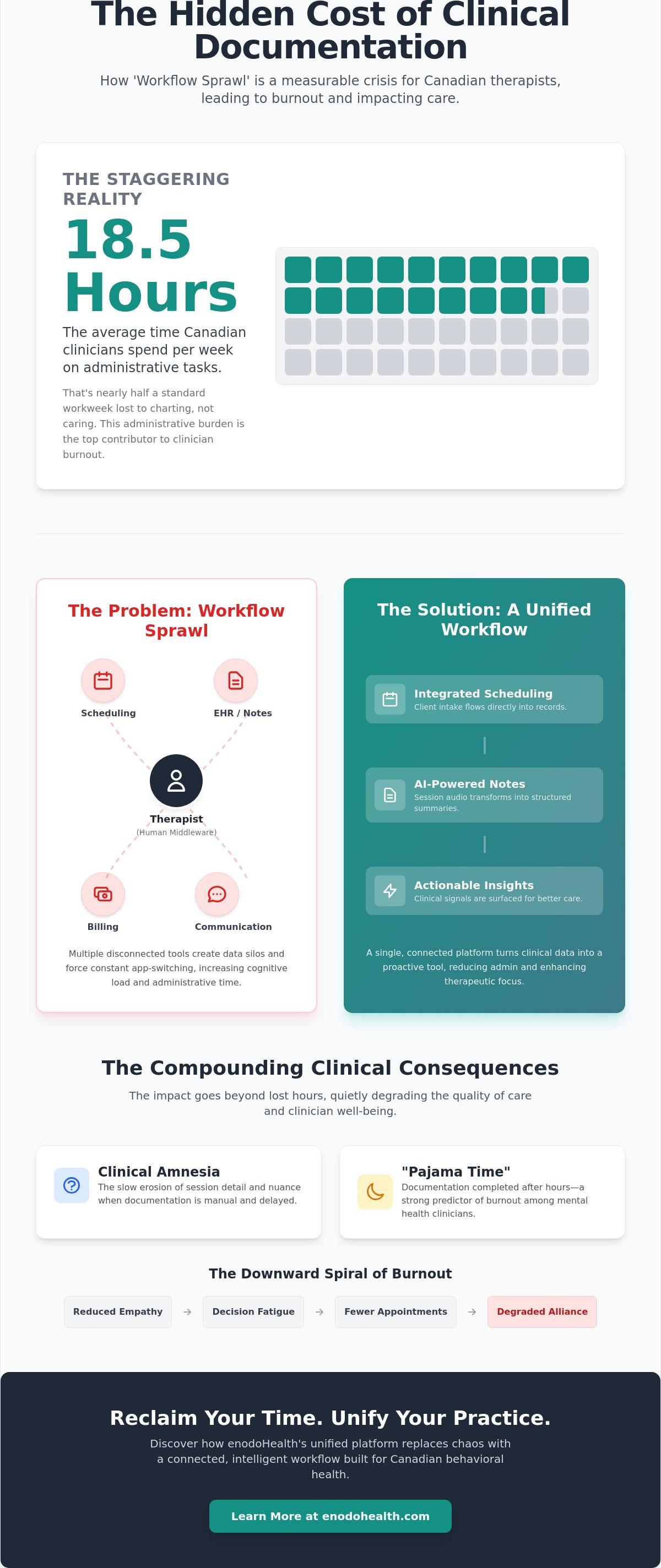
What if your clinical notes could do more than document a session - what if they could actively improve the next one? For therapists across Canada, that question still feels out of reach. A 2023 report from the Canadian Medical Association found that physicians and mental health clinicians spend an average of 18.5 hours per week on administrative tasks, with documentation consistently ranked as the top contributor to burnout. That's nearly half a standard workweek lost to charting, not caring.
You already know the feeling. The session ends, your client leaves, and the real work begins: pulling together three disconnected platforms, reconstructing the nuances of a 50-minute conversation from memory, and finishing notes well past dinner. It's not a workflow. It's workflow sprawl. And it's exhausting.
The good news is that AI clinical documentation for therapists has matured well beyond basic transcription. Today's responsible AI tools are built to preserve your clinical voice, meet Canadian privacy standards, and connect session insights directly to proactive, measurement-based care. This article breaks down exactly how that transformation works, what to look for, and how the right platform helps you reclaim your time without sacrificing an ounce of clinical nuance.
Key Takeaways
- Workflow sprawl - the fragmentation of disconnected clinical tools - is a measurable crisis for Canadian therapists, costing nearly half a workweek in administrative burden that compounds burnout over time.
- AI clinical documentation for therapists goes far beyond transcription: learn how Natural Language Processing transforms session conversations into structured, clinically accurate summaries that preserve your voice and judgment.
- Responsible AI is designed to support - never replace - your clinical expertise, and this article addresses the most common concern head-on: what happens to the nuance of your patient's story.
- Your clinical notes can become a proactive care tool: discover how AI-generated summaries surface longitudinal "clinical signals" that help you prepare smarter for every session.
- See how enodoCare and enodoAlly work together as a unified platform to replace the chaos of disconnected systems with one connected, intelligent workflow built for Canadian behavioral health practice.
The Hidden Cost of Workflow Sprawl: Why Manual Documentation is Failing Therapists
Workflow sprawl isn't just an inconvenience. It's a structural failure baked into how most Canadian therapists are expected to practice. At its core, workflow sprawl describes the fragmentation that happens when clinical data lives across multiple disconnected tools: one platform for scheduling, another for electronic health records, a third for billing, and a fourth for client communication. Each tool works in isolation. None of them talk to each other. And the therapist becomes the human middleware holding it all together.
The administrative weight of that fragmentation is measurable. According to the Canadian Institute for Health Information, Canadian healthcare providers spend approximately 19 to 20 percent of their working hours on documentation and administrative tasks. For a therapist running a full caseload, that translates to roughly one full clinical day lost every week, not to additional sessions, not to professional development, but to charting.
What competitors in this space often miss is that the problem isn't just the hours. It's what happens to clinical memory inside those hours. When a therapist reconstructs a session from notes written 90 minutes after the fact, critical nuance evaporates. A client's hesitation before answering a specific question. The shift in tone when a difficult topic surfaced. The offhand comment that might signal something deeper. This is what practitioners call clinical amnesia: the slow erosion of session detail that manual, delayed documentation inevitably produces. Responsible AI clinical documentation for therapists exists precisely to close that gap, not as a typewriter, but as a tool for clinical visibility.
The Impact of "Pajama Time" on Provider Longevity
"Pajama time" is the clinical community's term for documentation completed after hours, often at home, after dinner, after the energy needed for quality clinical thinking is long gone. A 2022 study published in the Canadian Journal of Psychiatry identified after-hours administrative work as one of the strongest independent predictors of burnout among mental health clinicians. The psychological toll compounds over months: reduced empathy, decision fatigue, and a shrinking capacity to hold space for clients who need it most. Fewer after-hours hours also means fewer available appointment slots, directly limiting the number of Canadians a therapist can meaningfully support. When administrative debt accumulates, the therapeutic alliance itself quietly degrades, as a clinician stretched thin simply cannot bring their full presence to every session.
Fragmented Tools vs. Unified Clinical Workflows
App-switching fatigue is real and clinically costly. Every context shift between platforms pulls a therapist's cognitive focus away from the patient's story and toward system management. Data silos compound this risk: when intake information doesn't connect to session notes, and session notes don't connect to billing or outcome tracking, critical patterns go undetected. A human-centric technology stack inverts this dynamic entirely. It treats clinical data not as isolated records to be filed, but as connected signals that build a richer, longitudinal picture of each client's journey. That's the standard against which any platform should be measured.
What is AI Clinical Documentation for Behavioral Health?
At its core, AI clinical documentation for therapists uses Natural Language Processing (NLP) to convert the organic, often non-linear flow of a therapy session into structured, clinically meaningful summaries. This isn't dictation software with a smarter interface. NLP models trained on behavioral health language can identify diagnostic themes, track mood language, flag risk indicators, and organize session content into formats that align with recognized clinical frameworks, all from a single session input. The technology in mental health treatment has advanced rapidly enough that the National Institute of Mental Health now identifies AI-assisted documentation as one of the most clinically significant emerging tools in behavioral health delivery.
One distinction worth making clearly: AI scribes and AI clinical summary generators are not the same thing. AI scribes operate in real time, capturing conversation as it happens, which works well in fast-paced medical settings. AI clinical summary generators work post-session, analyzing a complete input to produce a structured draft that reflects the arc of the entire conversation. For therapists, where the meaning of a session often only crystallizes toward the end, post-session summarization tends to produce richer, more clinically coherent documentation.
The concept that separates sophisticated behavioral health documentation from generic record-keeping is what clinicians call the "Golden Thread." This refers to the continuous, traceable link between a client's intake assessment, their evolving session notes, and their active treatment plan. When documentation is fragmented across disconnected tools, that thread breaks. A client's presenting concern from intake stops informing session priorities. Treatment goals drift from what was originally identified. AI documentation tools built for behavioral health are specifically designed to maintain that thread, ensuring every session note connects backward to the treatment plan and forward to the next clinical decision.
How AI Clinical Summaries Work
The process follows three stages: secure session input (whether through audio capture or structured therapist notes), NLP analysis that identifies key themes, emotional language patterns, and risk signals, and a structured clinical draft delivered for therapist review. That final step is non-negotiable. The "human-in-the-loop" requirement means a clinician reviews, edits, and approves every summary before it becomes part of the official record. AI generates the scaffold; clinical judgment completes the structure.
Key Features of AI Documentation Tools in 2026
The most capable platforms now go well beyond summarization. Look for tools that offer:
- Automated treatment plan suggestions drawn directly from session content, reducing the cognitive load of translating observations into goals
- Measurement-based care (MBC) integration, where standardized outcome metrics connect to session summaries rather than living in a separate silo
- Behavioral health-specific NLP trained to recognize clinical nuance, including ambivalence, avoidance patterns, and trauma-adjacent language that generic medical AI routinely misses
This is the shift from passive record-keeping to active clinical signals. Notes stop being a compliance artifact and start functioning as a living layer of clinical intelligence. If you're ready to see what that looks like in practice, explore how enodoAlly connects session insights to proactive care.
Responsible AI: Navigating Ethics, Privacy, and Clinical Accuracy
Responsible AI isn't a marketing phrase. It's a design philosophy with a specific meaning: technology that amplifies clinical judgment rather than attempting to substitute it. For therapists weighing AI clinical documentation for therapists, that distinction matters enormously, because the stakes of getting it wrong aren't measured in lost productivity. They're measured in missed diagnoses, eroded trust, and compromised care.
The objection surfaces in almost every conversation about AI in behavioral health: "What happens to the nuance of my patient's experience?" It's the right question to ask. A client's carefully chosen words, the pause before disclosing something difficult, the way they circled back to a topic they initially dismissed - these are the clinical signals that a generic transcription tool will flatten into text. Responsible AI is built specifically to preserve that texture, not by replacing the therapist's interpretive ear, but by giving it a more complete record to work from.
The Role of Clinical Judgment in an AI-Assisted World
Ethical AI acts as a second set of eyes, not a second voice. Every summary generated by a responsible platform arrives as a draft, not a final record. The therapist reviews it, edits where needed, and approves it before it enters the official chart. That "human-in-the-loop" requirement isn't optional or incidental; it's the ethical backbone of the entire system. One-click editing tools make that review fast without making it superficial. The AI brings structure and recall. The clinician brings meaning.
Security Standards for Behavioral Health Data
Compliance in Canadian behavioral health practice extends well beyond the baseline. While the HIPAA Privacy Rule requirements set a recognized floor for patient data protection, Canadian therapists operating under Ontario's Personal Health Information Protection Act (PHIPA) or British Columbia's Health Information Act face provincial obligations that go further. A platform that lists "HIPAA compliant" as its only credential is describing the minimum, not the standard.
Look for platforms that also hold SOC 2 Type II certification, which independently verifies that security controls are not just designed correctly but operating consistently over time. Secure patient portals with end-to-end encryption protect AI-generated insights in transmission, not just at rest. And de-identification matters at the model level: clinical NLP models should be trained on data stripped of personally identifiable information, so that no individual patient's story contributes to a training set without explicit consent.
One transparency requirement often overlooked: patients have the right to know when AI-assisted tools are part of their care. Informed consent processes should explicitly name any AI documentation tools in use. That conversation, handled well, often strengthens rather than undermines the therapeutic alliance, because it signals that their provider is thoughtful about how their information is handled.
Responsible AI clinical documentation for therapists isn't just ethically sound. It's what makes the technology sustainable in Canadian practice.
From Notes to Insights: Documentation as a Catalyst for Measurement-Based Care
A clinical note filed and forgotten is a missed opportunity. The real value of AI clinical documentation for therapists isn't the time it saves during charting. It's what the documentation can reveal when it's connected, searchable, and analyzed across the arc of a client's entire care journey. That's the distinction most platforms miss entirely: treating notes as endpoints rather than as the starting point for what comes next.
When AI-generated summaries are built into a unified platform rather than exported as standalone documents, patterns emerge that manual documentation simply can't surface. A client who consistently uses avoidance language in sessions three through seven. A gradual shift in emotional vocabulary that precedes a reported depressive episode by two weeks. These aren't observations a therapist can reliably reconstruct from memory across a full caseload. But they're exactly what connected clinical data can show.
This is clinical visibility: not cold metrics, but a richer, longitudinal picture of each client's journey told through both data and narrative together.
Closing the Loop with Measurement-Based Care (MBC)
Standardized assessments like the PHQ-9 and GAD-7 are only useful when they're in conversation with session content, not siloed in a separate intake form that never gets revisited. When AI-generated summaries connect directly to those scores, something clinically significant becomes possible: flagging when a client's narrative contradicts their assessment results. A client who reports a PHQ-9 score of 6 but whose session language reflects persistent hopelessness and social withdrawal deserves a closer look. That discrepancy is a signal. Integrated platforms surface it automatically rather than leaving it to chance.
The clinical evidence for this integration is substantial. Research published in the Journal of Affective Disorders found that consistent measurement-based care practices improve patient outcomes by 20 to 40 percent compared to treatment-as-usual approaches. The barrier has never been the evidence. It's been the workflow. When AI documentation automates the update of treatment plan milestones based on detected session progress, MBC stops being a documentation burden and starts being a natural extension of how you already practice.
Proactive Care: Identifying Signals Between Sessions
The space between sessions carries real clinical weight. enodoAlly's patient portal gives therapists visibility into client engagement patterns between appointments, including whether a client is completing check-ins, how their mood tracking is trending, and whether their language in portal messages contains any red-flag indicators that warrant earlier contact.
That shift, from reactive crisis response to proactive clinical intervention, is one of the most meaningful things a connected platform can enable. Identifying a client at risk before they arrive in distress is categorically different from responding after the fact.
This is where AI clinical documentation for therapists becomes something more than an efficiency tool. It becomes a clinical partner. See how enodoAlly turns session insights into proactive, measurement-based care for your practice.
Unifying Your Practice with enodoCare and enodoAlly
Every problem described in this article, the pajama-time charting, the disconnected platforms, the clinical signals lost between sessions, shares a single root cause: tools that were never designed to work together. enodoHealth was built as the direct antidote to that fragmentation. Not a better version of one piece of the puzzle, but a platform that replaces the puzzle entirely.
The philosophy is straightforward: connected, proactive, and human. Clinical data shouldn't require a therapist to act as the bridge between systems. It should flow intelligently, surface meaningful signals automatically, and leave the clinician free to do the work that only a clinician can do.
One Platform. Two Powerful Solutions.
enodoHealth delivers this through two integrated solutions that address distinct dimensions of practice.
enodoCare handles the operational foundation: automated scheduling that eliminates manual booking back-and-forth, integrated billing and invoicing that keeps revenue data connected to clinical records, and practice management tools that give solo practitioners and group practices alike a single administrative command centre. When your scheduling data, billing history, and client records live in the same system, you stop managing software and start managing care.
enodoAlly is where AI clinical documentation for therapists becomes a living part of your clinical workflow. AI-generated session summaries, measurement-based care tools, and a HIPAA-compliant patient portal work together to transform what your notes can do. Session insights don't expire when the chart is filed; they feed forward into the next session, the next treatment plan revision, and the next proactive outreach decision.
The critical advantage isn't either solution in isolation. It's the single source of truth they create together. When operational data and clinical data share one platform, patterns that would otherwise stay invisible become actionable. A client's appointment consistency, their PHQ-9 trend, and their session language all speak to each other rather than sitting in separate silos waiting for a therapist to manually connect the dots.
Getting Started with Responsible AI Documentation
The "Wise Ally" approach means implementation is designed around how therapists actually practice, not how software engineers imagine they do. enodoHealth supports both solo practitioners and multi-clinician group practices across Canada, with onboarding structured to reduce friction rather than create a new administrative project. The platform's human-in-the-loop design ensures that clinical judgment remains central from day one; AI drafts the structure, you complete the meaning.
Workflow sprawl isn't inevitable. It's a solvable problem, and the solution doesn't require trading clinical depth for operational efficiency. You can have both. Experience clinical visibility with enodoHealth and see what a connected, proactive, and human practice actually feels like.
The Practice You Were Trained to Run Is Still Within Reach
Workflow sprawl isn't a permanent condition. It's a solvable one. AI clinical documentation for therapists has matured to the point where Canadian practitioners no longer have to choose between clinical depth and operational sanity. The evidence is clear: fragmented tools erode clinical memory, accelerate burnout, and quietly limit how many Canadians can access quality care.
Three things are worth carrying forward. First, documentation delay costs more than time; it costs clinical nuance that can't be recovered. Second, connected data surfaces longitudinal signals that isolated notes never could. Third, responsible AI keeps your judgment at the centre, every single time.
enodoHealth was founded by clinical psychologists who understood these problems from the inside. The platform is HIPAA and SOC 2 compliant, built specifically for behavioral health workflows, and designed to be a wise ally rather than another tool to manage.
Your clients deserve a clinician who isn't running on empty. Replace workflow sprawl with clinical visibility and explore enodoHealth today. The practice you trained for is closer than it feels.
Frequently Asked Questions About AI Clinical Documentation for Therapists
Is AI clinical documentation HIPAA-compliant for mental health practices?
Yes, but compliance level varies significantly between platforms, so it's worth looking beyond the baseline. HIPAA sets a recognized minimum for patient data protection, but Canadian therapists practicing under Ontario's PHIPA or British Columbia's Health Information Act face provincial obligations that go further. A platform that lists HIPAA compliance as its only credential is describing the floor, not the ceiling.
Look for SOC 2 Type II certification alongside HIPAA compliance. SOC 2 Type II independently verifies that security controls aren't just designed correctly but operating consistently over time. enodoHealth meets both standards, with end-to-end encryption for data in transit and de-identified NLP model training that keeps individual patient information out of any training dataset.
How does AI capture the nuance of a therapy session without being reductive?
Responsible AI clinical documentation tools use behavioral health-specific NLP models, not generic medical transcription engines. These models are trained to recognize clinical language patterns including ambivalence, avoidance, and trauma-adjacent phrasing that a standard voice-to-text tool would flatten into plain text. The result is a structured draft that reflects the session's actual clinical texture, not just its surface content.
Critically, no AI summary becomes part of the official record without therapist review and approval. That human-in-the-loop step is where clinical nuance gets preserved or corrected. The AI produces the scaffold; your clinical judgment completes the meaning. Think of it as a highly attentive colleague who took detailed notes and then handed them to you for final interpretation.
Can AI summaries be used for insurance reimbursement and audits?
AI-generated summaries can absolutely support insurance reimbursement and withstand audits, provided the therapist reviews and approves each note before it enters the official chart. Insurers and auditors assess the clinical accuracy, completeness, and consistency of documentation, not the method by which the draft was produced. A reviewed and approved AI summary carries the same professional weight as a manually written note.
Where AI documentation adds particular audit value is consistency. Manual notes written at varying times after sessions often show gaps in structure or missing diagnostic language. AI-generated summaries built on behavioral health NLP produce consistently formatted records that align with recognized clinical frameworks, which tends to reduce the back-and-forth that audit requests typically generate.
Does using an AI clinical documentation tool require patient consent?
Yes. Patients have the right to know when AI-assisted tools are involved in their care, and informed consent processes should explicitly name any AI documentation tools in use. This isn't just an ethical best practice; it's increasingly a regulatory expectation under Canadian provincial privacy legislation, including PHIPA in Ontario.
That consent conversation, handled transparently, often strengthens rather than erodes the therapeutic alliance. Clients who understand that their provider uses thoughtful, privacy-protective technology to improve care quality tend to respond positively. Frame it accurately: the AI helps you document more completely so you can focus more fully on them during the session itself.
What is the difference between an AI scribe and an AI clinical summary generator?
An AI scribe operates in real time, capturing conversation as it happens. This works well in fast-paced medical settings like emergency departments or primary care, where speed and immediate documentation are the priority. An AI clinical summary generator works post-session, analyzing the complete session input to produce a structured draft that reflects the arc of the entire conversation, not just a transcript of its parts.
For therapy specifically, post-session summarization produces richer and more clinically coherent documentation. The meaning of a therapy session often only crystallizes near the end, and a real-time scribe can't retroactively weight early comments against later revelations. A summary generator processes the whole picture before producing anything, which is a meaningful clinical difference.
How much time can a therapist realistically save using AI for notes?
The Canadian Medical Association's 2023 data puts the average administrative burden for mental health clinicians at 18.5 hours per week, with documentation as the leading contributor. Studies of AI-assisted documentation tools in behavioral health settings consistently report time savings of 30 to 50 percent on post-session charting, which translates to roughly 2 to 4 hours recovered per clinical day for a full caseload.
The practical impact compounds beyond raw hours. Therapists using AI documentation tools report completing notes before leaving the office rather than finishing them after dinner, which directly reduces the "pajama time" that the 2022 Canadian Journal of Psychiatry identified as one of the strongest independent predictors of burnout. Less after-hours administrative debt means more cognitive capacity for clients the following day.
Can I integrate AI documentation with my existing billing and scheduling software?
Integration capability depends entirely on the platform. Many standalone AI documentation tools export notes as PDFs or plain text files, which still requires manual transfer into your billing or scheduling system, meaning you haven't actually eliminated the workflow sprawl; you've just added one more step to it.
A genuinely unified platform solves this at the architecture level. enodoHealth combines AI clinical documentation through enodoAlly with automated scheduling and integrated billing through enodoCare in a single system. Session notes, appointment records, and billing data share one source of truth, so clinical and operational information stay connected without any manual bridging between platforms.
Is AI clinical documentation available for therapists in Canada?
Yes, and the Canadian market has specific requirements that not all platforms meet. Canadian therapists must comply with provincial privacy legislation like Ontario's PHIPA or British Columbia's Health Information Act, which impose obligations beyond what U.S.-focused platforms are typically built to satisfy. Verifying that any platform you consider explicitly addresses Canadian provincial standards, not just HIPAA, is a non-negotiable first step.
enodoHealth is built specifically for Canadian behavioral health practice, with compliance infrastructure designed around both federal and provincial privacy requirements. The platform supports solo practitioners and multi-clinician group practices across Canada, with onboarding structured to reduce friction rather than create a new administrative project. Learn more about how enodoHealth supports Canadian therapists.