

What if the biggest obstacle to better patient outcomes isn't your clinical skill, it's your software stack? Behavioral health utilization has surged by over 60% since 2018, and Canadian therapists are feeling every bit of that pressure. The result is a familiar kind of chaos: scheduling in one platform, billing in another, and clinical notes living somewhere else entirely. That fragmented reality has a name, and it's workflow sprawl.
If you've ever ended a session only to spend the next hour chasing documentation across disconnected tools, you already know how exhausting this is. The administrative burden isn't just an inconvenience; it's quietly eroding the time and energy you should be spending with patients.
That's exactly the problem EnodoCare + enodoAlly was built to solve. In this article, you'll discover how the integration of these two purpose-built solutions eliminates workflow sprawl to create a practice that's genuinely connected, proactive, and human-centric. We'll walk through how each component works, how they reinforce each other, and why a unified ecosystem is the defining advantage for Canadian behavioural health practices heading into 2026.
Key Takeaways
- Workflow sprawl - the administrative chaos of juggling disconnected scheduling, billing, and documentation tools - is one of the most significant threats to clinical effectiveness for Canadian behavioural health providers in 2026.
- EnodoCare + enodoAlly form a unified ecosystem where operational efficiency and patient engagement reinforce each other, eliminating the need for fragmented software stacks across your practice.
- Responsible AI-powered clinical summaries and between-session patient engagement tools mean enodoAlly actively supports continuity of care without replacing your clinical judgment.
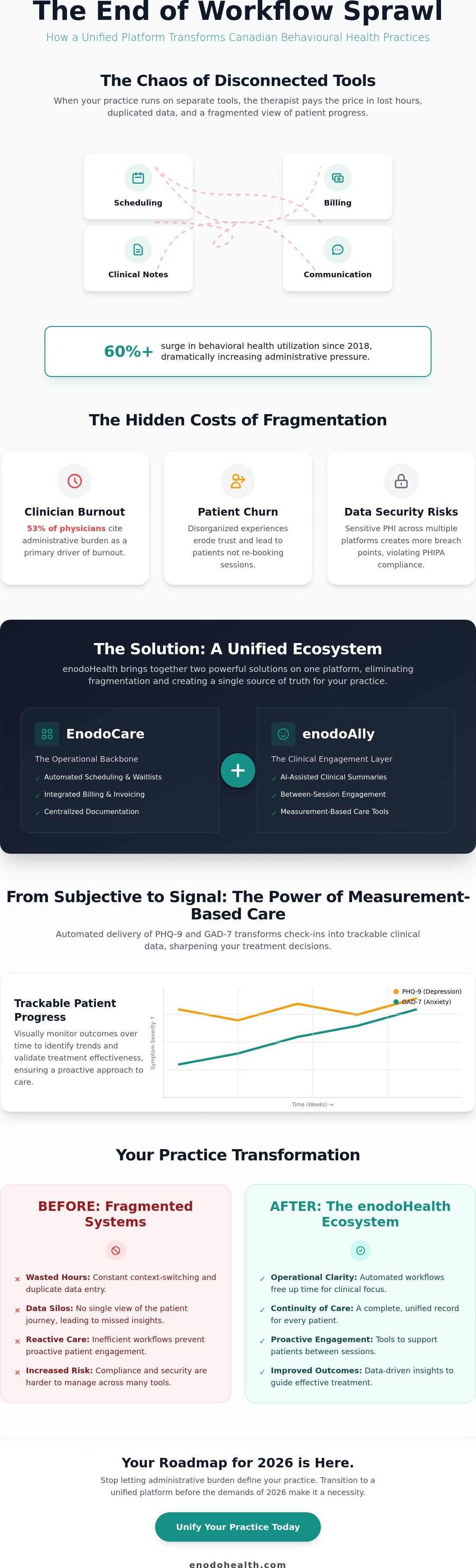
- Measurement-Based Care, including automated delivery of validated assessments like the PHQ-9 and GAD-7, transforms subjective check-ins into trackable clinical signals that sharpen your treatment decisions.
- Whether you run a solo practice or a multi-provider group, there is a clear, supported roadmap for transitioning to enodoHealth - including data migration assistance - before 2026 demands it.
Overcoming Workflow Sprawl in Modern Behavioral Health
Workflow sprawl is the primary barrier to clinical visibility: it's what happens when your practice runs on four different tools that were never designed to talk to each other. Scheduling lives in one app, billing in another, clinical notes in a third, and patient communication somewhere else entirely. Each system works in isolation, and the therapist pays the price in lost hours, duplicated data entry, and a fragmented picture of patient progress that makes confident clinical decisions harder than they need to be.
The enodoHealth philosophy is built around a direct counterpoint to that fragmentation. Connected, proactive, and human care isn't a marketing phrase; it's a structural commitment. Every design decision in the platform reflects the belief that technology should reduce the distance between a clinician and their patient, not widen it with administrative noise.
The High Cost of Fragmented Systems
The consequences of fragmented systems go well beyond inconvenience. A 2023 Canadian Medical Association report found that 53% of physicians and nurse practitioners cited administrative burden as a primary driver of burnout, a figure that tracks closely with the experience of registered psychotherapists and social workers running independent practices. When your attention is split between systems, patient retention suffers too; clients who feel their provider is distracted or disorganized are less likely to re-book. Data silos compound the risk further, because sensitive clinical information stored across unconnected platforms creates multiple potential breach points, a serious concern under Canada's Personal Health Information Protection Act and provincial equivalents. Fragmented tools don't just slow you down; they quietly undermine the trust your practice depends on.
One Platform. Two Powerful Solutions.
The integrated suite of EnodoCare + enodoAlly resolves this by separating responsibilities cleanly while keeping everything unified. EnodoCare handles the operational layer: automated scheduling, integrated billing and invoicing, and the administrative infrastructure that keeps a practice financially healthy. enodoAlly handles the clinical engagement layer: between-session patient support, Measurement-Based Care tools, and AI-assisted clinical summaries that sharpen your therapeutic focus. Neither solution tries to do everything. Together, they cover it all.
For Canadian behavioural health practices heading into 2026, this isn't a luxury upgrade. Regulatory complexity is increasing, patient expectations are rising, and the practices that thrive will be the ones with genuine operational clarity. A unified platform is no longer the logical evolution of practice management; it's the baseline requirement.
EnodoCare: Streamlining the Business of Behavioral Health
Every thriving practice is built on two foundations: the clinical work that happens in the room, and the operational infrastructure that makes that work possible. EnodoCare is purpose-built to own the second half of that equation. It functions as the operational backbone of your practice, handling the scheduling, billing, documentation workflows, and secure client communication that consume hours each week when left to fragmented, mismatched tools.
The American Medical Association has documented the measurable impact of streamlining the business of behavioral health through integrated workflow design, noting that well-structured operational systems directly reduce clinician burnout and improve patient access. EnodoCare translates that principle into a practical, Canadian-specific platform.
Automated Scheduling and Waitlist Mastery
Scheduling is where most practices bleed time invisibly. Phone tag, manual confirmations, and last-minute cancellations that leave gaps in a fully booked week add up fast. EnodoCare replaces that friction with a self-scheduling interface that lets clients book, reschedule, or cancel 24 hours a day without a single administrative touchpoint. Automated appointment reminders, delivered via the client's preferred channel, directly address no-show rates, which the Canadian Psychological Association estimates cost independent practices an average of 14% of scheduled session revenue annually.
Waitlist management adds another layer of practice intelligence. Rather than a static list of names in a spreadsheet, EnodoCare's waitlist tools actively match newly available slots to waiting clients, filling gaps before they become lost revenue. For a growing practice, that's not just operational efficiency; it's a patient access strategy.
Integrated Billing and Canadian Compliance
Billing is the area where compliance risk and administrative burden collide most visibly for Canadian behavioural health providers. EnodoCare handles automated invoicing and secure payment processing within a framework designed to meet HIPAA standards and align with provincial privacy legislation, including Ontario's Personal Health Information Protection Act and British Columbia's Personal Information Protection Act. Financial data doesn't sit in a generic payment processor with no health-sector context; it lives within the same protected environment as your clinical records.
The platform's financial reporting tools give solo practitioners and group practice owners genuine visibility into practice health: outstanding balances, session revenue trends, and billing cycle performance at a glance. That's the kind of clarity that turns reactive financial management into confident, forward-looking decisions.
The HIPAA-compliant patient portal ties it all together, serving as the secure gateway for document signing, intake forms, and client communication. No third-party document tools. No unsecured email threads. Just one protected environment where the administrative relationship with your client begins cleanly and stays that way.
If you're ready to replace the patchwork of tools currently running your practice, explore how EnodoCare can simplify your operations from day one.
enodoAlly: Human-Centric AI for Proactive Patient Engagement
EnodoCare handles the operational infrastructure of your practice. enodoAlly handles something equally critical: what happens to your patients between the sessions you've so carefully scheduled. That gap, the 167 hours between weekly appointments, is where therapeutic momentum can quietly erode. enodoAlly is the patient-facing companion built specifically to bridge it.
Research published by the human-centric AI team at the University of St. Augustine for Health Sciences confirms what many clinicians already sense intuitively: AI-supported patient engagement tools, when designed ethically and deployed thoughtfully, can meaningfully extend the therapeutic relationship beyond the clinical hour. enodoAlly was built with exactly that principle at its core.
AI-Generated Clinical Summaries: Saving Hours Weekly
Documentation is the tax on clinical care. The average Canadian registered psychotherapist spends between 90 minutes and two hours per day on progress notes and session summaries, time that belongs to patients. enodoAlly addresses this directly through AI-assisted clinical summaries that draft structured documentation based on session data, reducing that burden to a review-and-refine workflow rather than a blank-page exercise.
The framework governing this process is what enodoHealth calls Responsible AI: an ethical commitment to transparency, accuracy, and clinician oversight in every AI-generated output. No summary is presented as final. Every draft surfaces as a starting point for your clinical judgment, not a replacement for it. The distinction matters enormously in a regulated healthcare environment where documentation carries legal and professional weight. The result is a workflow where AI handles the mechanical scaffolding and you focus on the clinical substance that only you can provide.
Proactive Engagement Beyond the Session
enodoAlly gives patients a structured, secure channel to stay connected to their care between appointments. Mood tracking prompts, secure messaging, and validated check-ins create a continuous thread of engagement that keeps patients actively invested in their progress rather than passively waiting for the next session.
What makes this genuinely useful for clinicians isn't the data itself; it's the signal layer built on top of it. When a patient's mood tracking entries show a meaningful downward shift, or when engagement patterns suggest withdrawal, enodoAlly surfaces that pattern as a clinical signal requiring your attention. You arrive at the next session with visibility you didn't have before, not because you asked for it, but because the system was watching on your behalf.
That's the practical meaning of proactive care. Not reactive check-ins after a crisis, but early awareness that lets you intervene when intervention is still straightforward. Together, EnodoCare + enodoAlly ensure that neither the business nor the clinical relationship ever operates in the dark.
Measurement-Based Care: Turning Clinical Signals into Success
Measurement-Based Care (MBC) is the practice of systematically collecting standardized patient-reported outcomes at regular intervals and using that data to guide clinical decisions. Research published in Psychiatric Services (2019) found that MBC adoption improved treatment outcomes for depression and anxiety by up to 24% compared to care delivered without structured tracking. Despite that evidence, a 2022 survey by the Canadian Psychological Association found that fewer than 30% of independent behavioural health providers in Canada used any formalized outcomes measurement in their practice. The barrier wasn't skepticism; it was friction. Manually distributing, collecting, and scoring assessments like the PHQ-9 or GAD-7 across a full caseload is simply unsustainable without the right infrastructure.
That's the gap EnodoCare + enodoAlly closes directly.
Automating Outcomes Tracking
Within the enodoHealth platform, validated assessments are scheduled automatically based on your clinical preferences. A PHQ-9 can be queued to reach a patient's portal seven days before each session, a GAD-7 at intake and every four weeks thereafter, without a single manual step from your team. Patients complete assessments directly in the HIPAA-compliant portal, and their responses feed into the clinical record in real time. That eliminates transcription errors, removes the awkward paper-form handoff at session start, and means the data is already waiting for you before the conversation begins. enodoAlly then pulls those scores directly into AI-generated clinical summaries, so MBC data isn't siloed in a separate tracker; it's woven into the documentation workflow you're already using.
Visualizing the Journey: Data as a Therapeutic Tool
Raw scores don't change behavior. Visible progress does. enodoHealth renders outcomes data as clear, longitudinal progress charts that both you and your patient can review together. When a patient sees their PHQ-9 score drop from 18 to 9 over twelve weeks, that visual confirmation of movement is a therapeutic tool in its own right. It strengthens buy-in, reinforces the value of showing up consistently, and grounds the therapeutic relationship in shared, objective evidence rather than memory alone.
For clinicians, those same charts function as dynamic clinical signals. A plateau in GAD-7 scores after six sessions is a prompt to revisit the treatment approach. A sudden spike between appointments, surfaced by enodoAlly's between-session monitoring, becomes an early intervention opportunity rather than a crisis discovered at the next booking.
For group practices, this capability carries a competitive dimension too. Demonstrating measurable patient outcomes through structured MBC data is increasingly what insurers, employee assistance programs, and institutional referral sources in Canada expect before directing clients to a provider. It's not just good clinical practice; it's a market differentiator that solo practitioners using generic tools simply can't replicate.
Ready to bring structured outcomes tracking into your practice? See how enodoHealth's Measurement-Based Care tools work in practice.
Transitioning to enodoHealth: Your Roadmap for 2026
Knowing a unified platform exists and actually getting there are two different problems. The practices that will thrive heading into 2026 aren't the ones that recognized the need for change latest; they're the ones that started the transition earliest. Here's how that transition actually looks, from the first audit of your current tools to the moment your workflows are genuinely connected.
Implementing a Unified Workflow
Start with an honest inventory. Before onboarding anything new, map every tool your practice currently uses and assign each one a category. The audit is simpler than it sounds:
- Scheduling: Are you using a standalone booking tool, a generic calendar, or phone-based coordination?
- Billing and invoicing: Is your payment processing integrated with your clinical records, or does it live in a separate system?
- Documentation: Are progress notes stored in the same environment as your patient intake forms and signed consents?
- Patient communication: Are you relying on unsecured email or a third-party messaging app that wasn't built for regulated health data?
- Outcomes tracking: Are validated assessments like the PHQ-9 or GAD-7 being administered systematically, or only when you remember to print them?
Every "separate system" on that list is a sprawl point. Count them. That number is the clearest argument you'll ever have for consolidation.
Onboarding with enodoHealth is structured to minimize friction at every stage. Data migration support means your existing client records, appointment history, and billing data don't disappear into a transition gap; the enodoHealth team works alongside you to move them securely. EnodoCare's operational layer goes live first, stabilizing scheduling and billing before enodoAlly's clinical engagement tools are layered in. That sequenced approach means your practice never experiences a disruption to active patient care during the changeover.
The AI-assisted features in enodoAlly are designed to feel immediately intuitive. Clinical summaries surface as structured drafts, not blank forms. Automated assessment delivery requires a one-time configuration, not ongoing manual scheduling. The learning curve is measured in days, not months.
Future-Proofing Your Practice
The behavioural health landscape in Canada is shifting in three directions simultaneously: regulatory expectations are tightening, patient demand for between-session engagement is rising, and referral sources including employee assistance programs and institutional partners are beginning to expect documented outcomes data before directing clients to a provider. A practice still running on disconnected tools in 2026 won't just feel inefficient; it will be structurally disadvantaged in every one of those conversations.
Clinical visibility isn't a feature. It's the foundation of every confident treatment decision, every retained patient, and every referral relationship that compounds over time. The EnodoCare + enodoAlly suite was built to deliver exactly that: a practice where operations and patient engagement don't compete for your attention, they work together so your attention stays where it belongs, in the room with your patient.
enodoHealth's mission has always been straightforward: reduce the distance between a clinician and the care they want to deliver. Every scheduling automation, every AI-drafted summary, every mood tracking signal exists in service of that single goal. The technology is the infrastructure. The outcome is a practice that's genuinely connected, proactive, and human.
That practice is available to you now. Transform your practice with the EnodoCare + enodoAlly suite and enter 2026 with the clarity, capacity, and clinical confidence your patients deserve.
The Unified Practice You Build Today Defines Your 2026
Canadian behavioural health providers are navigating a convergence of pressures that fragmented tools simply weren't designed to handle: tightening provincial privacy regulations, rising patient expectations for between-session engagement, and referral sources that increasingly expect documented outcomes data before directing clients your way. Continuing to patch together disconnected scheduling, billing, and documentation systems isn't a neutral choice; it's a compounding liability.
EnodoCare + enodoAlly was built by clinical psychologists who've lived inside that liability. The result is a HIPAA-compliant ecosystem where operational efficiency and patient engagement reinforce each other, supported by responsible AI tools that sharpen your clinical judgment rather than sideline it. Scheduling, billing, outcomes tracking, and between-session support don't compete for your attention. They work together so your focus stays where it belongs: with your patient.
The practices that enter 2026 with genuine clinical visibility and connected workflows won't get there by waiting. They'll get there by deciding now. Unify your practice today with EnodoCare + enodoAlly and build the foundation your patients, and your future self, deserve.
Frequently Asked Questions About EnodoCare + enodoAlly
Is the EnodoCare + enodoAlly suite HIPAA and PIPEDA compliant?
Yes, the EnodoCare + enodoAlly suite is built to meet HIPAA standards and aligns with Canadian federal and provincial privacy legislation, including PIPEDA and its provincial equivalents such as Ontario's Personal Health Information Protection Act and British Columbia's Personal Information Protection Act. Every layer of the platform, from scheduling and billing to patient messaging and clinical documentation, operates within a single protected environment rather than routing sensitive data through third-party tools with no health-sector context.
How does the AI clinical summary generator protect patient privacy?
AI-generated clinical summaries in enodoAlly are processed entirely within the platform's HIPAA-compliant infrastructure, meaning patient data never passes through external AI services or unsecured processing environments. The output is always presented as a structured draft for clinician review, not a finalized record. That review step isn't optional; it's a deliberate design choice under enodoHealth's Responsible AI framework, ensuring that a regulated professional, not an algorithm, holds accountability for every entry in the clinical record.
Can I use EnodoCare without enodoAlly, or are they only available together?
EnodoCare is available as a standalone solution for practices that primarily need to consolidate their operational workflows: scheduling, billing, invoicing, and secure client communication. enodoAlly's clinical engagement and between-session support tools layer on top of that foundation. That said, the platform's greatest advantage emerges when both solutions are active together, because operational data and clinical signals then flow through a single connected environment rather than remaining separated.
Does enodoHealth support measurement-based care assessments like the PHQ-9?
The EnodoCare + enodoAlly suite supports automated delivery of validated assessments including the PHQ-9 and GAD-7, scheduled according to your clinical preferences without any manual steps from your team. Patients complete assessments directly in the HIPAA-compliant portal, and scores feed into the clinical record in real time. Those scores are then pulled directly into enodoAlly's AI-generated summary drafts, so outcomes data is embedded in your documentation workflow rather than living in a separate tracker you have to check separately.
What is the implementation process for moving my group practice to enodoHealth?
Onboarding for group practices follows a sequenced approach: EnodoCare's operational layer, covering scheduling and billing, goes live first to stabilize day-to-day workflows before enodoAlly's clinical engagement tools are introduced. Dedicated data migration support means existing client records, appointment history, and billing data transfer securely rather than disappearing into a transition gap. The enodoHealth team works alongside your practice throughout that process, and most practices report that the core learning curve for AI-assisted features is measured in days, not weeks.
How does enodoAlly help with patient engagement between therapy sessions?
enodoAlly gives patients a structured, secure channel for mood tracking, validated check-ins, and messaging during the roughly 167 hours between weekly appointments. What makes this clinically useful isn't just the data collected; it's the signal layer built on top of it. When a patient's between-session entries show a meaningful downward pattern, enodoAlly surfaces that as a clinical alert, so you arrive at the next session with early awareness rather than discovering a deterioration after the fact.
Does the platform handle billing and invoicing for Canadian therapists?
EnodoCare includes automated invoicing and secure payment processing designed specifically for Canadian behavioural health providers, operating within a compliance framework that addresses both federal PIPEDA requirements and provincial privacy legislation. Financial reporting tools give solo practitioners and group practice owners real-time visibility into outstanding balances, session revenue trends, and billing cycle performance. Because billing sits inside the same protected environment as your clinical records, financial data doesn't get routed through generic payment processors that lack any health-sector safeguards.
What happens to my data if I decide to switch platforms in the future?
enodoHealth's data portability approach means your clinical records, patient history, and billing data remain yours. The same migration support offered during onboarding applies in reverse: your data can be exported in structured formats rather than locked behind proprietary systems. Canadian privacy legislation, including PIPEDA, grants patients rights over their personal health information, and enodoHealth's architecture is built to honour those obligations rather than treat data retention as a switching-cost strategy.